
Contact tool setter
Measure the tool on the machine
S5TS contact tool setter — length, diameter and breakage detection
Setting tool length by hand is one of the largest sources of idle time on a machining centre. On small-diameter cutters, breakage often goes unnoticed and bad parts pass on to the next operation. S5TS solves both problems inside the machine’s own cycle.
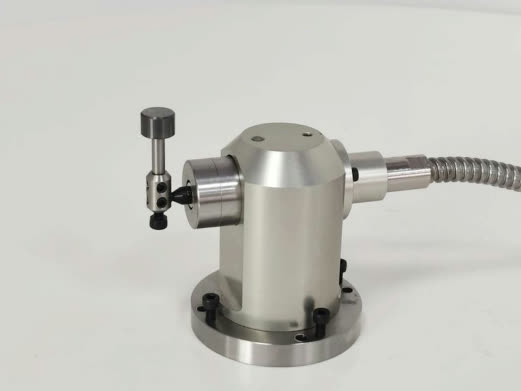
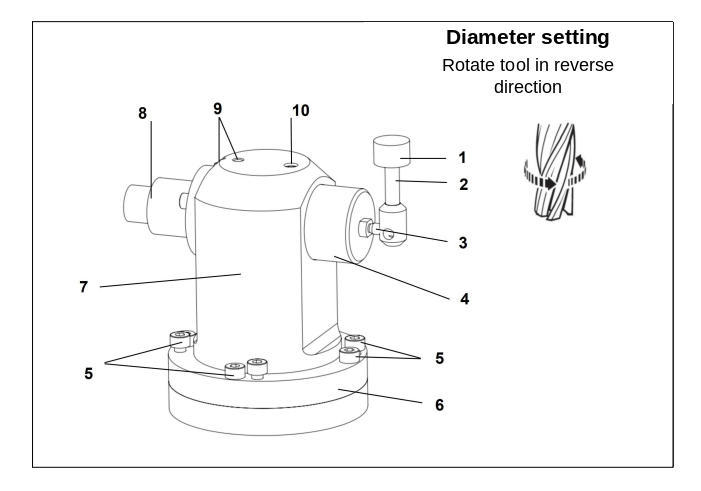
Length and diameter with one device
S5TS measures both tool length and tool diameter. Both measurements are taken on the same contact surface: the cylindrical contact element carried on a vertical stem beside the body. For length the tool descends onto the top face of this element; for diameter it approaches its side face. The part above the body is not the contact surface but a protective cap.
Both measurements are taken in the same cycle and the values are written directly into the tool offset table. Devices that measure length alone cannot see diameter wear; S5TS closes that gap.
Kinematic resistive triggering
The device works on the kinematic resistive principle. The contact element sits on three ball seats under spring force; when it touches a surface the contact area in the seats reduces, resistance rises and a signal is produced. When contact is released the mechanism reseats itself within 1 micron. This reseating stability is the basis of repeatability.
Pre-travel is zero: triggering happens at the moment of contact and does not wait for the element to travel a distance. Over-travel protection is ±12.5 degrees in the XY plane and 6.35 mm in Z. Trigger life is more than 10 million operations and the contact surfaces are tungsten carbide.
Wear and breakage inside the cycle
The tool is measured before it starts work and again after it finishes. The difference between the two measurements shows the wear. When the difference exceeds the permitted value the machine raises an alarm and reports that compensation is needed; in the case of breakage the cycle is stopped. The decision does not wait for the operator.
Shop-floor conditions
The body is sealed to IP68 and has a double-protection structure; coolant and swarf cannot reach the mechanism. The cable is oil resistant, 3 metres as standard and can be changed on request. The minimum bending radius is R7. The LED on the device is normally off and lights at the moment of triggering, so operation can be confirmed visually.
Supply is 24 V DC, 20 mA. The output is a normally open contact. Because the signal is transmitted by cable there are no battery, pairing or line-of-sight issues. Control units in common use across the industry are supported.
| Model | S5TS |
|---|---|
| Measurement | Tool length and diameter; broken tool detection |
| Sensing directions | 5 directions (±X, ±Y, +Z) |
| Repeatability | 1 µm |
| Pre-travel | 0 |
| Over-travel protection | XY: ±12.5° Z: 6.35 mm |
| Contact force | XY: 0.4 – 0.8 N Z: 4.0 N |
| Trigger life | More than 10 million |
| Contact material | Tungsten carbide |
| Smallest tool detected | Ø1.0 mm |
| Sealing | IP68, double protection |
| Signal transmission | Hard-wired |
| Output | Normally open contact |
| Supply | 24 V DC, 20 mA |
| Cable | Oil resistant, 3 m standard (minimum bending radius R7) |
| Surface finish | Ground |
| LED | Normally off, lights on triggering |
Where it is used
Standard solution on machines where a cable can be routed
Machines whose table does not need to rotate
Machining centres of every size, small to large
Engraving and precision machining centres
Wireless tool setter
Routing a cable to a tool setter is not possible on every machine. If the table moves, if the cable duct is full, or if the device is removed and refitted often, the cable becomes a limitation. SOTS offers the same measuring mechanism without a cable.
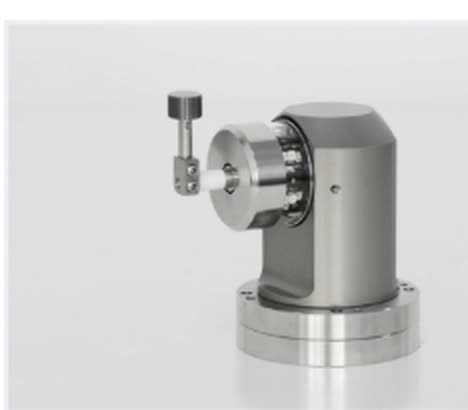
Same mechanism, without the cable
SOTS uses the same kinematic resistive mechanism as the hard-wired model. The contact element sits on three ball seats under spring force; at contact the resistance rises and a signal is produced. Repeatability is 1 micron and trigger life is more than 10 million operations. Pre-travel is zero. Over-travel protection is ±12.5 degrees in the XY plane and 6.35 mm in Z. The body is sealed to IP68 and the contact surfaces are tungsten carbide.
The measurements are the same as well: tool length and diameter are measured, wear is monitored and breakage is detected within the cycle. The only difference is how the signal is transmitted.
Modular design
SOTS is not a stand-alone device. It consists of a measuring probe, a bracket and a stylus kit. The probe is mounted on the bracket and the bracket is fixed to the machine table. This design provides two things: there is no cable, and the device can be removed and moved to another machine in minutes.
Automated tool setting
The tool length is measured to establish the height offset and to check that the length is within tolerance. The diameter is measured while the tool turns at its own speed, and the tool size offset is set from that value. Errors from manual setting and manual data entry disappear.
In-process control
Broken tools are detected during machining. Tool wear is compensated using measurements taken between machining steps. When wear exceeds the permitted value the machine raises an alarm and reports that compensation is needed. Control units in common use across the industry are supported.
| Model | SOTS |
|---|---|
| Output | Normally open contact |
| Sensing directions | 5 directions (±X, ±Y, +Z) |
| Repeatability | 1 µm |
| Pre-travel | 0 |
| Over-travel protection | XY: ±12.5° Z: 6.35 mm |
| Contact force | XY: 0.4 – 0.8 N Z: 4.0 N |
| Trigger life | More than 10 million |
| Contact material | Tungsten carbide |
| Smallest tool detected | Ø1.0 mm |
| Sealing | IP68 |
| Output type | Normally open contact |
| Surface finish | Ground |
What going wireless gives you
Can be used on machines where no cable can be routed
No cable problem on machines with a moving table
Can be removed and relocated in minutes
The repeatability figure is that of the device itself; the positioning error of the machine is not included. Accuracy achieved in the field depends on how the device and the machine behave together.